


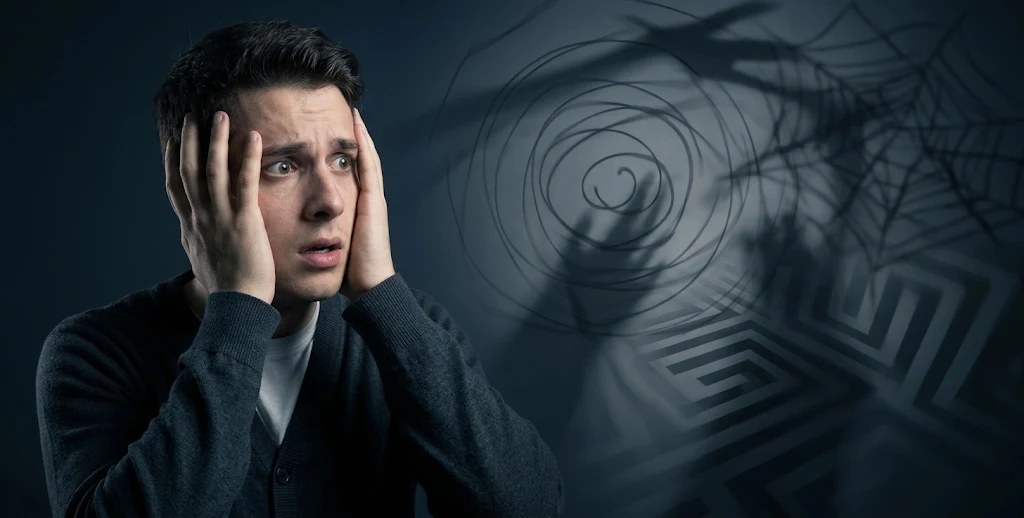
Why Do Phobias Develop? The Role of Learned Fears and Life Experiences
Encountering an animal, getting on a plane or being in an enclosed space can trigger intense fear for some people. When this fear arises despite little or no actual danger and significantly affects daily life, it may be a phobia. There is rarely one simple explanation for how phobias develop. Personal experiences, reactions learned from others and individual vulnerabilities may all play a part.
What is a phobia?
Fear is a natural response that helps us react to possible danger. A faster heartbeat, tense muscles or an urge to leave can be protective when a real threat is present. With a phobia, however, the intensity of fear may be out of proportion to the actual risk. A person may feel strong anxiety even while anticipating contact with the feared object or situation.
The presence of fear alone does not determine whether someone has a phobia. Its intensity, persistence and impact on daily life also matter. For example, someone who repeatedly cancels trips because of a fear of flying, or avoids certain places in case they encounter an animal, may find that fear restricting their life.
Can phobias be learned through experience?
Some phobias are associated with a frightening or distressing experience. A child who is chased by a dog, for instance, may later expect danger when they see one. A turbulent flight may also contribute to a fear of air travel.
In these situations, the mind links an event with a particular object or situation. Later, encountering that cue can activate the body’s alarm response, even when the original event is not happening again. But not everyone who experiences something frightening develops a phobia. The same event can affect people differently, and some people do not remember a specific experience that explains when their fear began.
Can fear be learned by observing others?
Phobias do not only develop through events a person experiences directly. People can also learn about danger by observing how others respond. A child who sees a parent become highly anxious around dogs or planes may begin to view those situations as threatening too.
Warnings and stories can also shape a person’s sense of risk. Hearing repeatedly that an object or situation is dangerous may contribute to anxiety, even without a direct negative experience. This does not mean that fear is inevitably passed from one person to another. What someone observes is only one possible influence, alongside their own experiences and individual characteristics.
How can avoidance keep fear going?
Leaving or avoiding a feared situation can reduce anxiety in the moment. That temporary relief may make avoidance more likely next time. Yet the person then has fewer opportunities to discover that the situation can be safe or that the expected outcome may not happen. As a result, the fear may persist. Over time, someone may begin to avoid not only the situation itself, but also the anxiety they expect to feel there.
Avoidance can seem protective in the short term, while gradually narrowing a person’s daily life. This might mean staying away from social activities, postponing medical appointments or being unable to travel. Understanding a phobia therefore involves looking at avoidance and its impact, as well as the fear itself.
Biological vulnerability and environmental factors
It would be incomplete to explain phobias only as learned fears. Research suggests that both genetic and environmental factors may be involved. A family history of anxiety or a tendency to feel especially anxious in unfamiliar situations may influence someone’s sensitivity to fear. This does not mean that a phobia will definitely develop. A vulnerability is not, by itself, a cause or a diagnosis.
Psychotherapy support for phobias
Understanding how a fear may have developed can give someone a useful way to make sense of their reactions. However, it may not be possible to identify one event that started the fear, and finding such an event is not always necessary for progress. In psychotherapy, a person may explore how the fear arises, the thoughts and physical sensations that accompany it, and the ways avoidance affects their life. The approach can be shaped around the person’s needs and the nature of the phobia.
If fear is limiting your daily life or influencing important decisions, you may consider speaking with a mental health professional. A phobia is not a personal failure or a lack of willpower. Understanding how fear is learned and maintained can support the development of new ways to respond to it during psychotherapy.
